New organs for humans can be
- Grown in vivo using stem cells
- Artificially grown in vitro (in a lab)
- Grown in a genetically modified animal (xenotransplantation).
- Built as a machine (cyborgisations)
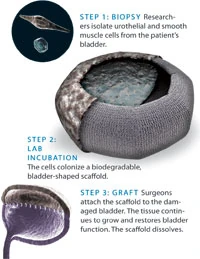

How a new bladder is grown
Organs can be grown from a few cells "manually" using artificial scaffolding. Or they can be grown inside cloned organisms. The scaffolding may in time be produced using printing based manufacturing, i.e. built up in layers, as this allows precise and custom control of the shape.
It will also become possible to make human organism regenerate organs in vivo (like the regeneration-capable mice, 2005), once we understand our genes better.
Cyborgisation
- See: cyborg
One of the major subjects that have caught everyone's attention in medical science is the development of artificial organs. An artificial organ is a man-made organ that is implanted in human body to replace its natural counterpart. The pace, at which, scientists are doing experiments with the artificial body parts, somehow it seems like we would be able to create a real human being very soon in the near future.
Here is a list of top 10 technologies that are vying to make this possible.
- Artificial Wombs - Status: Feasible, Prototypes developed successfully
- Artificial gut - Developed sucsessfully
- Artificial heart - First implantable artificial heart: Jarvik-7, 1982. First fully implantable artificial heart: AbioCor, 2001.
- Artificial blood - Oxygen therapeutics under development
- Artificial blood vessels - Under trials for use in human beings
- Artificial bones - Under clinical trials
- Artificial Skin - Research is underway for generating real skin
- Artificial Retina - Developed successfully, waiting for commercialization
- Artificial limbs - Modernized versions in trials
- Artificial body parts from Stem cells - Prototypes developed, further research on the way
regeneration
The techniques of "regenerative medicine" help the body rebuild itself. Clearly the cells of the human body "know" how to grow a finger, a liver, a pancreas, etc. -- they did it once just before birth. Adult sharks grow new teeth; adult salamanders grow entire new hands -- why not humans?
Results
- In 2006, medical researchers led by Anthony Atala and Alan Retik announced that they had largely regrown bladders on biodegradable scaffolds made of a synthetic polymer and collagen (image right), using their patients' own cells. Since patient's own cells were used, there was no risk of organ rejection. All 7 patients are ok.
- Also in 2006, Wada, Tanaka, Kojima, Inamatsu, Yoshizato and Moriyama announced succesful reconstruction of inner ear tympanic cavity and mastoid cavity in rats using a biodegradable collagen scaffold[1] . Experiments that predate this by a number of years have succesfull regrown outer ear, allowing control over the shape of the ear through shaping of the scaffold structure.
- Teeth can be regrown in-situ using an ultrasonic device that stimulates regrowth of tooth buds[2].
- In 2010, Eleni V. Antoniadou, representative from Transplants Without Donors LLC, presented the next generation of tissue engineered scaffolds for nerves, arteries, ears and skin using nanotechnological techniques and nanotextiles.
Pace of Development
The 2006 result with implanted bladders in human patients, built on work done in 1999 in which researchers in Wake Forest Institute for Regenerative Medicine grew a new dog bladder from a few cells and successfully transplanted this lab-grown organ in a dog.
Animal organs
Human DNA is inserted into the genome of the host animal, usually a pig. Immunosuppresnats may be used to prevent rejection of the organ by the pig. When mature, the organ is then taken from the animal and transplanted into the human patient - xenotransplantation. The South Korean government has started a large R&D project to make this a common procedure in medical practice by the end of this decade.
Artificial womb
An Artificial womb is a substitute for a human womb. These are a likely byproduct of developments in human cloning (for the design for early stages) and reproduction sciences (incubators, etc. - for the design for the late stages). Other technology that may feed in to this is the experience in blood purification equipment used in dialysis.
An artificial womb is not for implantation within the body, and the support equipment can consequnetly be considerably larger.
With such technology the gestation period might well be controllable, possibly shorter than 9 months. In some science fiction similar technology is also used for growing spare parts for individuals, possibly not growing a complete individual.
Sociopolitical
- In Larry Niven's science fiction:
- Convicted criminals are cut up for spare parts.
- People in Cryogenic storage who have gone bankrupt are harvested for spare blocked parts.